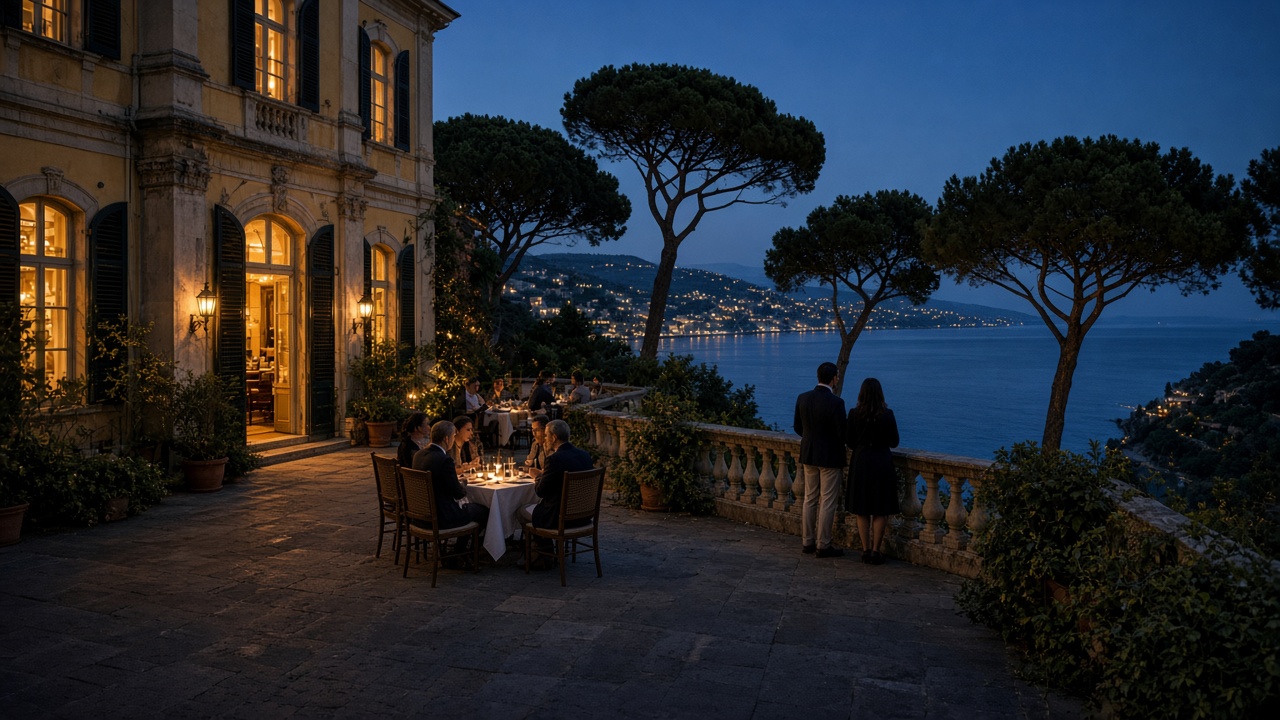
The Adriatic, considered as a wedding destination.
Croatia works differently from Italy. The strongest destination weddings here are rarely a single room with a view. They are composed around how historic towns, waterfront hotels and islands sit in relation to one another — and how people actually move between them, often by sea.
For an international celebration, the question is also access: where guests land, where they sleep, whether those beds can be held together, and how several days sit along the Adriatic rather than against it.
How the house works in Croatia
Access, rooms, then the days
The outline starts with who lands where, which hotel or house can hold the group, whether a boat is actually required, and how several events can be distributed across a weekend without turning the Adriatic into a commute. Transportation is written into the same conversation as the table.
Regions
Different Adriatics, different logistics.
Dubrovnik, Hvar, Central Dalmatia, Istria and Kvarner are not interchangeable stretches of the same coast. They ask different questions of airports, hotels, boats, and how a wedding weekend is actually held. Read them as a decision about movement and rooms — not as five versions of the same photograph.
Dubrovnik & South Adriatic
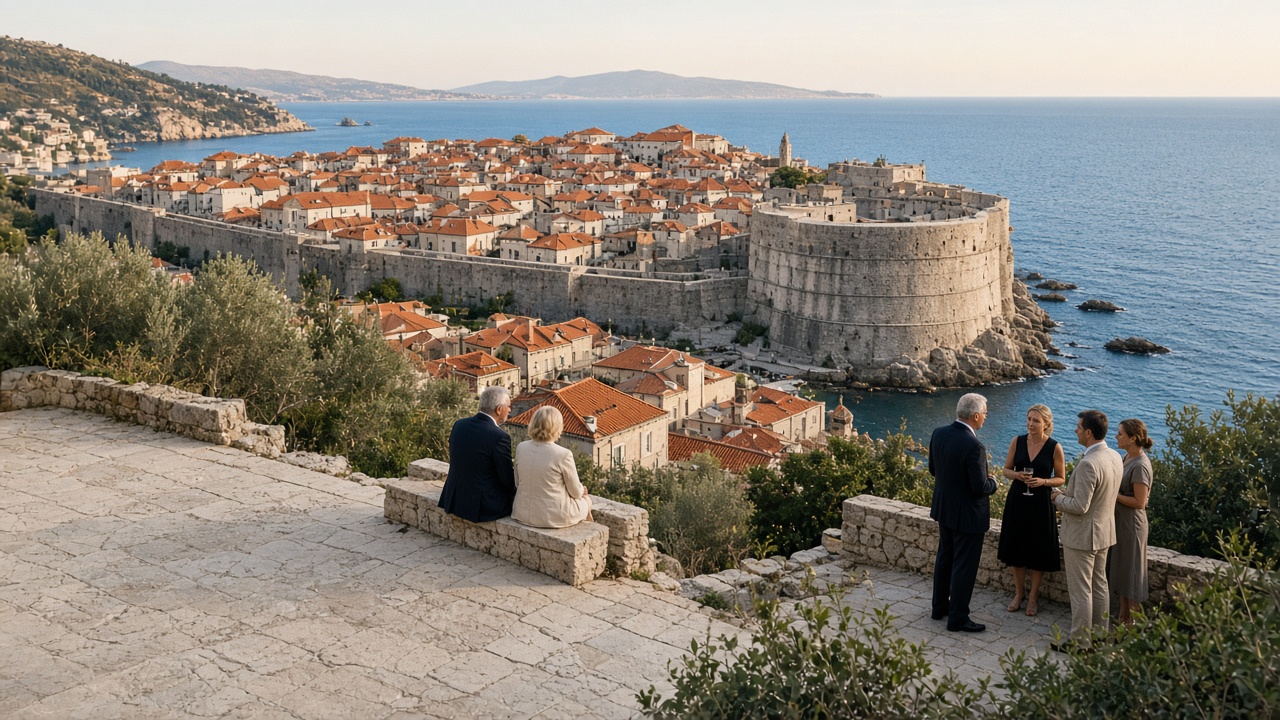
Dubrovnik is internationally recognisable, which is both an advantage and a constraint. Heritage architecture, limestone streets and the water sit close together; so do visitors. A wedding holds here when historic fabric and the Adriatic are part of the celebration itself — a waterfront hotel, a private house, a terrace that can actually be reached — and when the Old Town is treated as an operational geography, not a monument booked by name.
The old centre is largely pedestrian. Vehicles do not go where a map suggests they might. Guests in evening clothes, luggage, and anything required for dinner have to be moved with that in mind. Accommodation is usually concentrated in hotels along the water or just outside the walls; villas exist, but they do not automatically sleep the people who have flown. Moving between rooms and events is the day’s quiet design problem. Historic sites and protected interiors are not assumed to be available for private events; permissions, if they exist at all, are specific and slow.
Dubrovnik Airport is the usual gate for the south. From there, the outline is cars, timing, and whether the first night absorbs jet lag before anyone is asked to walk on limestone. Boats can add an hour on the water; they do not automatically solve a guest plan, and they do not run around weather. A weekend can use more than one setting — a welcome by the sea, a ceremony held where it can actually be produced, a later room that still works if the wind rises — provided each move is written, not improvised. Privacy here is hours, which house is held, and whether the celebration shares a public street at the wrong time of day.
How a wedding holds in the city — rooms, the Old Town, the south as one arrival system — is set out separately: Dubrovnik.
Strongest when historic architecture and the Adriatic are part of the celebration itself, and logistics are planned around them rather than treated as an afterthought.
Hvar
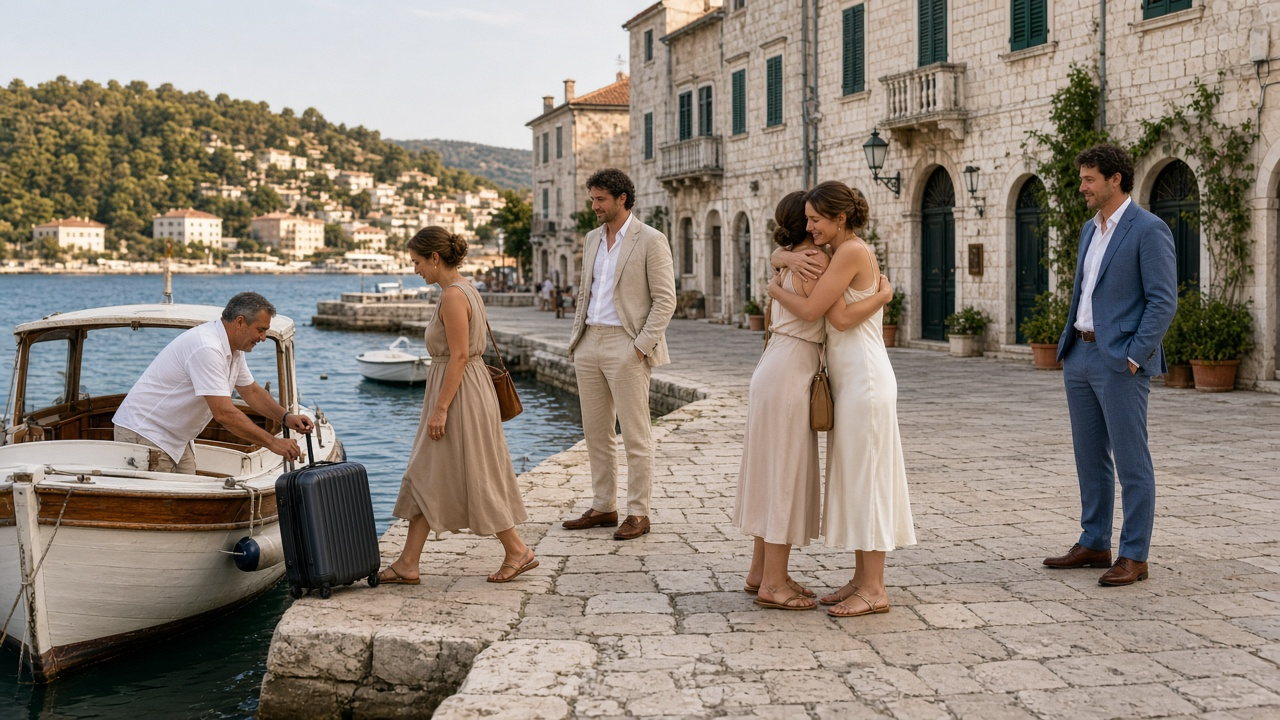
Hvar is an island wedding weekend. Heritage, hotels, restaurants and waterfront rooms exist; what distinguishes the destination is that transport is part of the wedding architecture. Guests do not simply arrive. They land, usually through Split, then continue by scheduled catamaran or ferry, or by private boat when the group, the luggage and the sea conditions justify it. Private transfers are not automatically preferable. A public sailing can be the calmer, more honest choice. A private boat can be the right one when timings, privacy or reduced walking matter — and when the weather will actually allow it.
Arrival timing is the first hospitality decision. Luggage does not float as easily as people. A late flight into Split and a last crossing is how the welcome dinner starts with missing bags. Accommodation should be concentrated: a hotel that can hold the group, or a small cluster of properties within a walk, not a scatter of houses that turns every breakfast into a transfer. Welcome events, the ceremony and dinner, and a day-after on the water or at a beach club all work when they sit inside one island plan — and when an indoor room exists if the sea will not.
Sea conditions are not a footnote. Wind and swell change whether a boat day is a gift or a cancellation. Contingency is a second room, a mainland delay, or a programme that can lose the water and still hold. Hvar is a poor fit for a celebration that treats the island as a pretty day trip from Split. It is a strong fit when the group commits to several nights, and nobody is left sleeping on the wrong side of the channel.
How the island weekend is actually held — the crossing, the towns, the rooms — is set out separately: Hvar.
Strongest when the island is held as a weekend, and the crossing is designed as part of the wedding rather than left to the morning of.
Split & Central Dalmatia
Split is the bridge: a historic city, a mainland coast, and a gate toward the islands. Split Airport is one of the more useful international doors on the Adriatic, which is why Central Dalmatia often works for groups who want the sea without making every guest a ferry passenger. The city can hold a welcome, a dinner, a hotel base. Nearby mainland stretches can hold a quieter house. The islands remain optional — a day, a continuation — rather than a mandatory crossing on the wedding morning.
The historic centre is stone, pedestrian in places, and already public. Wedding operations here are hospitality: which hotel can concentrate the group, how cars actually approach, whether a terrace can be used in wind, and how a multi-day programme moves between city, coast and, if wanted, water. Diocletian’s Palace is part of the city’s fabric. It is not the plan. A celebration that treats Split only as a monument tour will feel like one. A celebration that treats it as an arrival city with rooms, kitchens and a harbour will not.
Central Dalmatia is often the more practical Adriatic answer when guest stamina, luggage and older relatives matter, or when the outline needs a mainland road as well as a view of the sea. It is less convincing when the brief is a private island and the city is being used only as a photograph. Guest travel and hotel sourcing belong in the same conversation as the table.
How the city and the mainland coast actually hold a wedding — airport, rooms, optional islands — is set out separately: Split & Central Dalmatia.
Strongest when the city, the mainland coast and the sea are one outline — and guests are not asked to live as if they were already on an island.
Istria
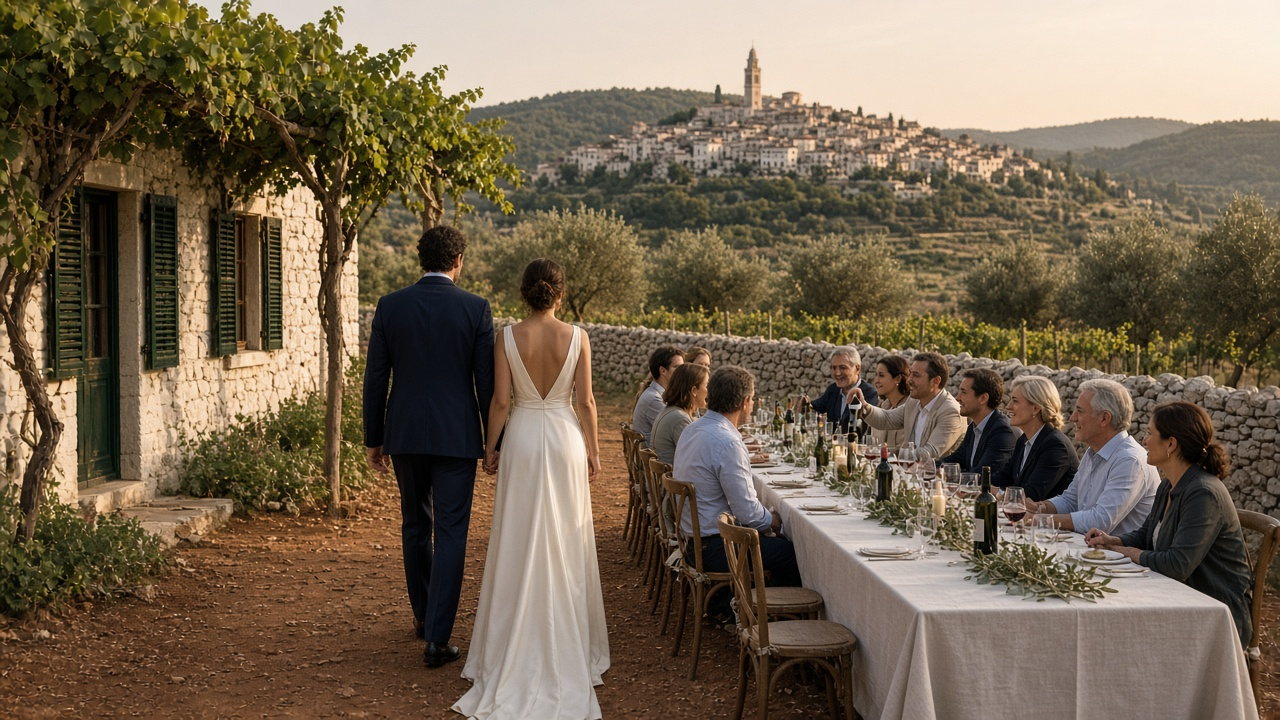
Istria is not a Dalmatian island with extra hinterland. It is a peninsula of private estates, wine country, hill towns and a separate Adriatic — with boutique hotels and resort beds along the coast when the group needs them. Official tourism presents it as a wedding destination for exactly those reasons: medieval towns, historic houses, restaurants and wineries that can hold a meal, a tasting, a second night. The identity is Istrian: white stone, terra rossa, olives, Malvasia and Teran, a hill town on the skyline. It is not a substitute Italy.
Logistics here are largely by road. That is the point. Guests can be concentrated around one estate, or in a small geographic pocket, without a ferry timetable. Airports that are actually useful depend on the exact house — Pula for much of the peninsula, sometimes Venice, Trieste or Ljubljana for guests coming from Italy, Slovenia or Central Europe, Zagreb when that is the honest long-haul door. The estate is chosen relative to those arrivals, not as a photograph first.
Food and wine are not decoration. They are how a multi-day programme occupies the hours between events without sending everyone to a different town. A welcome at the house, a wedding day that can move indoors, a lunch in the landscape, a coastal morning if the sea is wanted: the outline works when it stays inside one geography. Coastal properties exist; they do not automatically cancel the inland logic. Privacy is a held estate, not a public harbour at noon.
How the peninsula works as a wedding landscape — estate or coast, road, several days — is set out separately: Istria.
Strongest when the wedding is conceived as several days around one landscape rather than a single coastal event.
Kvarner & Opatija
Opatija is a historic resort: Habsburg-era hotels, a waterfront promenade, a gulf rather than an open island channel. Contemporary hospitality sits inside that older identity — grand rooms, terraces toward the Kvarner, hotels that already know how to sleep, feed and move international guests. For a wedding, that is not atmosphere. It is operations. Groups can be concentrated in one house, or in two hotels along the same stretch, with breakfast and a rain room already in the building.
Road access is the other argument. Italy, Slovenia, Austria and Central Europe are not a theoretical hinterland; they are how some families actually arrive, by car or by a short sequence of trains and transfers. Rijeka is the nearby city. Airports that matter depend on guest origin — Rijeka’s own airport, Zagreb, sometimes Venice or Ljubljana — and on season. The useful question is not which airport is closest on a map, but which one the people who are coming can actually use, on the days they are travelling.
A hotel-based weekend is often the cleanest Kvarner outline: welcome, wedding, a slower morning, private transfers that do not require a boat. A buyout is considered where a property will actually sell exclusivity; many will not, and a well-held room block can be the more precise answer. Nearby islands can extend the days after. They are optional. They should not become mandatory logistics for a celebration that was chosen precisely because the hotel could hold the group. This is where how the house works shows: hospitality first, then the ceremony inside it.
How the riviera actually holds a wedding — the promenade, the road, optional islands — is set out separately: Kvarner & Opatija.
Strongest when the hotel can hold the group, and the gulf is used as hospitality rather than as a daily crossing.
International guests
Bringing everyone to Croatia
Guest logistics should be designed before the wedding programme is finalised, not after. The operational difference between a mainland wedding, a historic city wedding and an island wedding is not a matter of taste. It is a matter of what people can reasonably do on the days they have.
Air. Relevant airports can include Dubrovnik, Split, Zagreb, Pula and Rijeka. They are not equally useful for every destination, and they are not equally useful in every season. Dubrovnik serves the south. Split serves Central Dalmatia and is the usual mainland gate for Hvar. Pula is often the honest door for Istria. Rijeka sits in the Kvarner picture. Zagreb is a national gate, then a road — right for some origins, a long continuation for others. The airport is chosen for the people who are coming, not for the name of the region.
Sea. Scheduled ferries and catamarans are public infrastructure: they have hours, luggage limits, and weather. Private boats can tighten a timing or reduce walking; they can also be the first thing that fails when the wind rises. Neither is a default. Arrival should be thought of in waves — who lands when, who waits with the bags, who is already at the hotel — rather than as a single glamorous crossing.
Road. Coaches and private transfers do the mainland work, until a historic centre refuses the vehicle. Concentrating accommodation is how those journeys stay short. Scattering guests across a town, an island and a second bay is how the wedding becomes a transfer. The same guest-system questions — rooms, arrivals, movement, destination capacity — are set out for Italy in the Journal: managing international wedding guests. Croatia changes the water. It does not change the need to design the people first.
Where people sleep
Hotel, resort, or private property
A hotel or resort is often operationally stronger in Croatia when the group needs concentration: breakfast, housekeeping, someone at the desk, more than one room that can hold an event, and a place to go if the weather turns. That is hospitality, not a lesser version of a villa.
A private estate or villa can offer privacy, architectural identity, and a greater sense of residence. It can also fragment the beds, create a transport requirement between sleep and dinner, and constrain production — kitchens, power, indoor volume, where suppliers actually unload. On islands those differences become particularly important. A beautiful house that cannot sleep the cousins is not a simpler wedding. It is two logistics plans.
Buyouts are considered where a specific property will sell exclusivity. They are not assumed. The operational difference between holding a whole hotel and holding a private house is set out, for Italy, in the Journal: hotel buyout or private villa. The article is not Croatia-specific. The questions travel.
Several days
A Croatia wedding as a journey
Every programme depends on destination, property, guests, season, and the sea where it applies. One way a celebration can be composed:
Day 1 · Arrivals
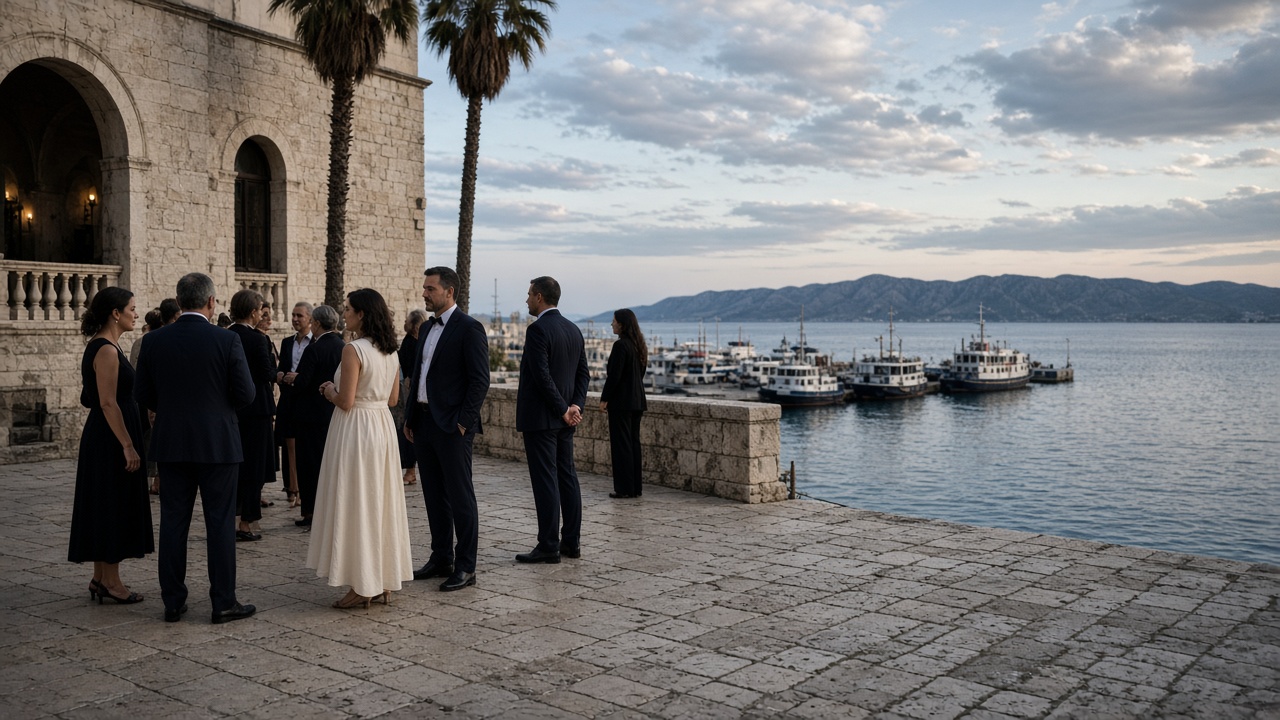
Guests land. Rooms are ready. A welcome by the water — or in the house that will hold them — absorbs the journey rather than asking for evening clothes on the same afternoon as the last flight.
Day 2 · The place, slowly
A local lunch, a rehearsal, an informal gathering. Enough of the destination is used that the wedding day does not have to perform the entire country.
Day 3 · The wedding
Ceremony and dinner in rooms that can actually be produced, with an indoor counterpart if the weather will not hold, and movement that has already been walked.
Day 4 · Recovery
A long lunch, a boat day, a beach, or simply the hotel. Recovery is an event only if the group wants one. It is still part of the outline.
Day 5 · Private travel
Those who are leaving, leave. Those who are continuing — islands, Istria, a crossing into neighbouring country, a honeymoon — do so from a plan that was written with the wedding, not after checkout.
After the last toast
Wedding, then private travel
The wedding does not have to end at checkout. Croatia sits in a geography that can continue: other Croatian islands, a slower Istria, Montenegro where the south already points that way, Slovenia from the north, Venice and northern Italy, or a wider private European journey. None of these is a tour. Each is a decision about pace and who is still travelling.
OHH! WEDDING and OHH! ITALY connect the celebration with what follows: guest departures, the rooms after, the transfers that are no longer a wedding movement. The honeymoon is designed in the same language as the days before it — not as a brochure added at the end.
Civil marriage
Can foreign couples legally marry in Croatia?
Foreign citizens can marry in Croatia under the applicable Croatian conditions. In outline, the file often includes birth records, proof of free marital status, confirmation that there is no legal impediment and that the marriage will be recognised where that confirmation is required, identification, and proof of citizenship. Croatian translations are commonly needed. Legalisation or apostille can apply, depending on the documents and the treaties in force.
This is not legal advice. Requirements depend on nationality and personal circumstances and should always be confirmed with the competent Croatian registry office, well in advance of the date. A symbolic celebration and a civil marriage are different undertakings; the outline should say which one is being held.
Before we begin
Questions that usually arrive first
Is Croatia a good destination for a luxury wedding?
Croatia can hold a luxury destination wedding when the location is chosen for access, rooms and several days — not only for a view. Historic towns, islands, estates and hotel coastlines behave differently. The work is hospitality and movement: where guests land, where they sleep, and whether the Adriatic is a corridor or a constraint.
Where are the best places for a destination wedding in Croatia?
There is no single best place. Dubrovnik concentrates heritage and waterfront hotels; Hvar asks for an island weekend; Split and Central Dalmatia often simplify mainland logistics; Istria suits an estate held over several days; Kvarner and Opatija are hotel coastlines with road access from Central Europe. The better question is which geography can actually hold the people.
Can international guests attend a wedding in Croatia easily?
They can, when arrivals are designed before the programme. Mainland and hotel destinations are usually simpler than islands. Useful airports depend on the region — Dubrovnik, Split, Pula, Rijeka or Zagreb are not interchangeable. Ferries, private boats and coaches are chosen for that specific journey, not as a default.
Is Hvar suitable for a multi-day destination wedding?
Yes, when the island is treated as a wedding weekend rather than a day trip. Guests typically reach Split first, then continue by scheduled catamaran or ferry, or by private transfer when that is justified. Accommodation should be concentrated. Sea conditions and luggage belong in the outline, not as an afterthought.
Should we choose Dubrovnik or Hvar for our wedding?
They answer different briefs. Dubrovnik is a recognisable historic city with waterfront hotels and Old Town constraints. Hvar is an island: transport is part of the architecture, and the group usually stays several nights. Neither is automatically more private or more practical. The decision follows guest origin, season and whether the sea should be crossed.
Can we buy out a hotel in Croatia for a wedding?
Sometimes, where a property will actually sell exclusivity. Many will not. A room block, or holding one hotel as the centre of the weekend, can be the more honest answer. Buyout availability is property-specific and seasonal. It is never inferred from a photograph or from a destination name.
Is a hotel or private villa better for a Croatia wedding?
A hotel or resort is often stronger for concentrating beds, breakfast, housekeeping, rain rooms and guest services. A private estate can offer privacy and a sense of residence, at the cost of fragmented accommodation and more production. On islands those differences become acute. The same operational questions are set out, for Italy, in the Journal.
How do wedding guests reach the Croatian islands?
Usually through a mainland airport — Split is the usual gate for Hvar — then by scheduled ferry or catamaran, or by private boat when the group, luggage and sea conditions justify it. Private boats are not automatically better. Arrival waves, weather and where people sleep on the island should be decided before invitations go out.
Can foreign couples legally marry in Croatia?
Foreign citizens can marry in Croatia under the applicable Croatian conditions. Documentation typically includes birth records, proof of free marital status, confirmation of no legal impediment where required, identification and proof of citizenship, often with Croatian translations. Requirements depend on nationality and personal circumstances and should always be confirmed with the competent Croatian registry office.
Can OHH! WEDDING organise the honeymoon after a Croatia wedding?
Yes. The wedding does not have to end at checkout. OHH! WEDDING and OHH! ITALY can connect guest departures with a private continuation — Croatian islands, Istria, Montenegro or Slovenia where they make sense, Venice and northern Italy, or a wider European journey — held in the same outline as the celebration.
Private concierge
Begin with the Adriatic, or with the people
A stretch of coast you already love, a season, and how many people should be close. If Croatia is not the answer, say so — the conversation is still the right first step.